Thursday, October 31, 2013

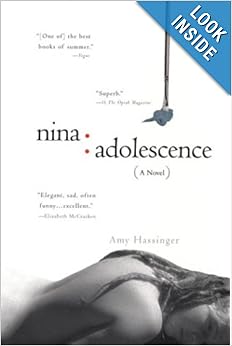
NINA: ADOLESCENCE by Amy Hassinger

Technically, Nina: Adolescence is not historical fiction. It's categorized as simply fiction. It's also not marketed as young adult fiction, although the main character is fifteen. However, the time period takes place around 1987, so those under the current drinking age might indeed consider it historical fiction. Regardless, I read this beautiful story so I decided to review it here. I purchased this book from the author, Amy Hassinger, at a writing conference I attended last June.

Nina: Adolescence tells the story of an adolescent Nina who struggles with problems both relatively common (sexuality, body changes) and relatively uncommon (little brother's death, adultery) for teens. The story is told solely from Nina's point of view with no head-hopping and no omniscience. I read this book in three sittings over a one week period so on the can't-put-it-down-scale of one for I couldn't even finish it to ten for I was up until the wee morning hours, I would give it an eight.

The year of 1987 wasn’t referenced (or at least I didn't pick it up) until about mid-book; however, I could tell it wasn't contemporary by the mention of using the paper card catalog at the library and the lack of mention of cell phones or computers. The story struck me as someone looking back over her teen years, discovering how the past led her to the choices she made, but showing that rather than stating it outright.

Nina is a compelling character and she ate at me even when not reading; for the first time in a long, long time, I found myself thinking about her between readings and I could read for two hours feeling like it passed in an instant. I was only occasionally jolted back to reality by my son's video games or the infrequent need to re-read a sentence. The images in the book are startling; they are detailed but in a new way, more detailed in the feeling rather than the tangible.

The themes of teenage depression and being lost are universal so the uniqueness of this story was how they manifested. At the end, Nina seems okay; she comes clean with her parents and starts medication, leading me to question if it was a brain chemical imbalance causing her problems all along. Therapy is mentioned but there are not a lot of details about it, but do I even need those details? The reader knows the problems centered around Nina dealing with her brother’s loss, exposure by her mother in her paintings and over reliance on her until her mother didn’t need her any longer, breakdown of her parents’ marriage, and the guilt over believing she was responsible for her brother’s death. These are obvious, but I’m still wondering about simply coming clean and getting on medication leading to her recovery. But maybe that’s the way it is. I cannot attribute my recovery from teen depression to any one thing; it was a just a gradual realization and decision to live. Maybe one just spirals down as far as he or she can go so all there is to do is to pick back up?

But these questions, these thoughts, these contemplations are what I loved about this book. It made me think about my own life and human behavior. There is no mystery in how what Nina experienced led to her choices and suffering, but those experiences were not so clear to Nina or those around her at the time. This book is not for those interested in vampires, werewolves, or fantasies but those who want to think about and experience one perspective about the real problems and falterings of the human mind.

Overall, the book was superb. I found the writing quality, pace, plot, and characters excellent.


Source: Hassinger, Amy. 2003. Nina: Adolescence. Blue Hen Books: New York.

Thursday, October 10, 2013

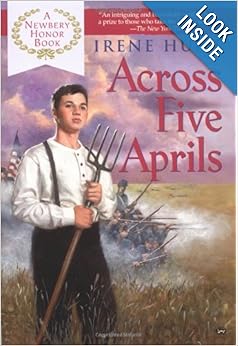
ACROSS FIVE APRILS by Irene Hunt

I found this book on Amazon via a general search for civil war historical fiction. I was especially attracted to the premise because the story centers around the home front in Southern Illinois. Since my book also takes place around the time of the civil war in the Midwest, I wanted to see how Irene Hunt handled the subject. It is a Newberry Honor book suitable for juveniles, and, with the historical information and story structure, would be a good read for them.

Across Five Aprils begins in April of 1861 with Jethro, a nine-year old boy, and his mother, planting potatoes. Although the story does continue through April of 1865, the bulk of the story takes place in 1861 to 1862, with only the last few chapters covering the final years of the civil war.  Perhaps it was a choice or a coincidence, but I believe this reflects how the war itself seemed to drag on to those at home and, to those outside of active battlefields, perhaps became just a fact of life until the end neared. The book's climax seems to coincide with the war itself's as well.

The story was engaging; I read it in approximately a week and a half so on a can't-put-it-down-scale of one for I couldn't even finish it to ten for I was up until the wee morning hours, I would give it a five and a half.

At some points, I had the sense of having the benefit of the knowledge of the future rather than the story taking place in that time frame. For example, the author referred to a "cornshuck bed;" to be writing from the perspective in that time period, I think one would have simply wrote, "bed." She also mentioned a field of study and clarified with it was "later called physics." This is not bad and is likely beneficial for the young readers who comprise target audience. It was just something that stood out.

The point of view seems to be third person omniscient but with the bulk of the story limited to Jethro's perspective. I'm not sure if this so-called "head hopping" was intentional or not. Jethro is definitely the main character experiencing the character arc. During the story, he goes from being a naive boy excited about the prospect of war to a mature boy knowing first-hand the horrors of war experienced at home. At the end, the readers gets a sense that the civil war made or perhaps allowed him to become a man earlier than he otherwise might have been. He is conflicted about his own views of the war; he's influenced by those around him though he realistically doesn't ever seem to form a solid opinion.

I enjoyed the plot points of this book. Of course, it contained the usual themes one would expect in a civil war period book: who will survive the war, who will die, who will desert, how how hard it is at home, etc. This story's plot also includes a deadly accident suffered by Jethro's sister, Mary, prior to the story opening, the romance between his sister and his teacher, and strife between family members.

The author is adept at bringing in her descriptions and appearances subtly and naturally. She also does a good job of conveying the varying views about the civil war within the north, south, and individual households. The scenes about Jethro's adventures spending the night at his sister's beau's home and going to town also adds to the tension and interest of the story.

As I've noticed in other books set in the civil war time period, the author sometimes resorts to summary, especially when talking about the battles and politics of the war. This has me questioning the necessity of these battle descriptions. One the one hand, the characters would be concerned with them, but other than what they actually say to each other about them or experience personally, I'm not sure it's needed. However, if people were obsessed about the war as the characters in this book seem to be, perhaps it is necessary, but, instead of summarizing, I might make it a topic of dialogue more often than Ms. Hunt did. I think this is a personal author-choice that I must resolve in my own work.

Overall, the book was about a family going through a difficult time. I found the writing quality, pace, plot, and characters above average.

Source: Hunt, Irene. 2002. Across Five Aprils. Berkely JAM: New York.

Thursday, September 19, 2013

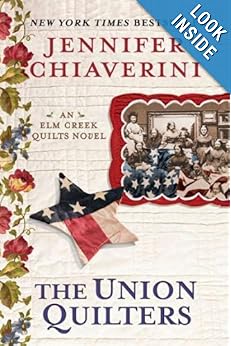
THE UNION QUILTERS by Jennifer Chiaverini

Photo from Amazon.com
My current novel project takes place in Camanche, Iowa, from 1859-1861. I heard Jennifer Chiaverini speak at a luncheon, but not being a quilter or even enjoying the act of pulling thread through fabric, I wasn't so much interested in her books as I was in her as a successful author. That changed on July 17th when I stumbled across her The Union Quilters novel on the bargain rack at my local Barnes and Noble.

The Union Quilters begins near the beginning of the American Civil War. The main story ends prior to its conclusion with an Epilogue dated 1868. The story was well-told; I read it in a little over a month so on a can't-put-it-down-scale of one for I couldn't even finish it to five for I was up until the wee morning hours, I would give it a three and a half.

The story provided a good history lesson of the Civil War. I enjoyed the letters that arrived home to the Elm Creek Valley from the enlisted men, although they got a bit a long at times. The story contains many characters and it took many pages before I could learn who they were enough to keep them straight. It seemed that Gerda was the main character.

Other than the typical plot lines one would expect to find in a book covering the Civil War of who lived and who died, other plot lines included the missing Joanna and the scandalous alleged love affair between Gerda and Jonathan, this last plot line being most intriguing to me. Gerda also seemed to be the character to experience the greatest character arc, coming to accept her situation by the end of the story and realizing the greatest internal change. The story seemed to divert its focus away from Gerda and her story at times, which disappointed me since I perceived her to be the main character.

I also found myself a bit bored occasionally with all of the battle descriptions, but perhaps that's because I've done so much research on the topic. I found myself wishing the story would've just stuck with the home front; there is already so much literature available about Civil War battles, but for the most part, it was interesting.

Overall, the book was well-written and free of typos as one would expect from Dutton. I found the pace, plot development, characters, enjoyability, and insightfulness above average. As a writer, I might have leaned more toward dialogue and scene-building than toward exposition. There was a lot of summary, but, overall, it was an easy read and beneficial to my studies.

Source: Chiaverini, Jennifer. 2011. The Union Quilters: An Elm Creek Quilts Novel. Dutton: New York.

Monday, August 12, 2013

Under Development

Thanks for stopping by. I'm a historical fiction author who reads historical fiction for work and fun so I thought, I'm reading historical fiction anyway, why not start blogging about what I'm reading? I plan to comment on story, character, plot, and other aspects of interest to readers and/or writers.

I'm still reading, working out details, and getting a few blog posts together so stay tuned. Currently I'm reading The Union Quilters by Jennifer Chiaverini so look for that review soon. If you have a historical fiction book you'd like me to review, please send me a short description of the book in an email to jodie@wordsywoman.com and I'll let you know if I'd be interested in reading it for a potential review. I'll also consider historical non-fiction that reads like a story or novel. Please be patient for a response since I'm just getting this blog started.

In the meantime, to learn more about me, please visit my Wordsy Woman website.

Thanks!