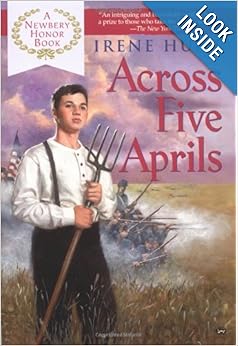
 I found this book on Amazon via a general search for civil war historical fiction. I was especially attracted to the premise because the story centers around the home front in Southern Illinois. Since my book also takes place around the time of the civil war in the Midwest, I wanted to see how Irene Hunt handled the subject. It is a Newberry Honor book suitable for juveniles, and, with the historical information and story structure, would be a good read for them.
Across Five Aprils begins in April of 1861 with Jethro, a nine-year old boy, and his mother, planting potatoes. Although the story does continue through April of 1865, the bulk of the story takes place in 1861 to 1862, with only the last few chapters covering the final years of the civil war. Perhaps it was a choice or a coincidence, but I believe this reflects how the war itself seemed to drag on to those at home and, to those outside of active battlefields, perhaps became just a fact of life until the end neared. The book's climax seems to coincide with the war itself's as well.
The story was engaging; I read it in approximately a week and a half so on a can't-put-it-down-scale of one for I couldn't even finish it to ten for I was up until the wee morning hours, I would give it a five and a half.
At some points, I had the sense of having the benefit of the knowledge of the future rather than the story taking place in that time frame. For example, the author referred to a "cornshuck bed;" to be writing from the perspective in that time period, I think one would have simply wrote, "bed." She also mentioned a field of study and clarified with it was "later called physics." This is not bad and is likely beneficial for the young readers who comprise target audience. It was just something that stood out.
The point of view seems to be third person omniscient but with the bulk of the story limited to Jethro's perspective. I'm not sure if this so-called "head hopping" was intentional or not. Jethro is definitely the main character experiencing the character arc. During the story, he goes from being a naive boy excited about the prospect of war to a mature boy knowing first-hand the horrors of war experienced at home. At the end, the readers gets a sense that the civil war made or perhaps allowed him to become a man earlier than he otherwise might have been. He is conflicted about his own views of the war; he's influenced by those around him though he realistically doesn't ever seem to form a solid opinion.
I enjoyed the plot points of this book. Of course, it contained the usual themes one would expect in a civil war period book: who will survive the war, who will die, who will desert, how how hard it is at home, etc. This story's plot also includes a deadly accident suffered by Jethro's sister, Mary, prior to the story opening, the romance between his sister and his teacher, and strife between family members.
The author is adept at bringing in her descriptions and appearances subtly and naturally. She also does a good job of conveying the varying views about the civil war within the north, south, and individual households. The scenes about Jethro's adventures spending the night at his sister's beau's home and going to town also adds to the tension and interest of the story.
As I've noticed in other books set in the civil war time period, the author sometimes resorts to summary, especially when talking about the battles and politics of the war. This has me questioning the necessity of these battle descriptions. One the one hand, the characters would be concerned with them, but other than what they actually say to each other about them or experience personally, I'm not sure it's needed. However, if people were obsessed about the war as the characters in this book seem to be, perhaps it is necessary, but, instead of summarizing, I might make it a topic of dialogue more often than Ms. Hunt did. I think this is a personal author-choice that I must resolve in my own work.
Overall, the book was about a family going through a difficult time. I found the writing quality, pace, plot, and characters above average.
Source: Hunt, Irene. 2002. Across Five Aprils. Berkely JAM: New York.