The Mida by Lyle Ernst and Kimberly Sigafus, according the the back-of-book blurb, takes place in 1952. However, it's not historical per se. Other than the subtle absence of cell phones and computers, the story would fit into most any time period.
The book tells the story of a time-traveling circus headed up by an Ojibwa woman and the trouble it faces in the current, as-of-the-story, time and through time itself. There are numerous characters and the story is written in the third person omniscient point-of-view. The main characters seem to be Mesa, the carnival owner, and Tony. But it's hard to tell if that was the authors' intent as many of the characters are central to the story.
It took me awhile to catch on to who-was-who, but I was able to do so as the tangled mysteries unfolded. (To help, the authors might consider a free character guide download.) These mysteries involve murder, the carnival's existence, romance, and family ties. It has something for just about everyone: twists, betrayal, loss, violence, superheroes, and witches. I can't pigeon-hole it into just one genre - it's part fantasy, part murder-mystery, part romance. But once I was able to get over the hump of learning the characters, I found myself hooked in the story and wondering how it would turn out. I can't say the ending was a complete surprise - but only because I had no suspicions about "who done it." There's really no more I can say without the risk of giving away spoilers...
I enjoyed Lyle's and Kimberly's writing. The book contained lots of good dialogue, interesting phrases, subtle humor, and fresh ways of describing scenes.
The Mida is a good read. On a can't-put-it-down-scale of one for I couldn't even finish it to ten for I was up until the we hours, I give it a seven and a half.
(P.S. I've received insider information that a sequel is in the works and I'm looking forward to seeing what trouble these characters get themselves into next.)
Source: Ernst, Lyle & Sigafus, Kimberly. (2014). The Mida. McIver Publishing: Freeport, Illinois.
Friday, January 30, 2015
Tuesday, January 13, 2015
THE TIME TRAVEL TRAILER by Karen Musser Nortman
The Time Travel Trailer provides a glimpse of life during several different time periods. The first thing I noticed was the realness of the writing. Life with the teen daughter, especially during the earlier part, is totally accurate. There is also plenty of humor with distinctive character voices. I especially enjoyed the mother's, Lynne's, slightly sarcastic voice.
Nortman's historical facts are weaved beautifully throughout the story and ground it in time - we get information about happenings, court cases, and events we've likely heard about before. The story is told through short, easily digestible chapters; you can pick it up, read a few chapters, quickly do what you have to do, and jump right back in without having to thumb through to see how many pages the next chapter has so you can decide if you have time to start reading. As I read, I was continuously curious about what Lynne and Dinah would find and in what year they would find themselves placed.
The story is told through Lynne's and Dinah's point of view (Lynne's in first person and Dinah's in third) in no-particular-order alternating chapters or chapter groups. After the first few chapters from Dinah's point of view, I wasn't sure of the purpose of the alternating viewpoints and wondered if it would add to the story. As the story unfolded, however, I learned how Dinah's unique perspective fit in and I can't think of a way the author could've handled it differently.
The Time Travel Trailer, in addition to providing an interesting history lesson, develops into a double mystery - what happens along the way and what happened with the trailer's original owner. As mentioned above, during the first approximate one-third of the book, I wondered where the story was going, but then the suspense picked up, keeping me turning the pages and reading "just one more chapter" before putting it down for the night. Nortman doesn't disappoint in her mystery writing ability, either; the end provides a satisfying conclusion.
The Time Travel Trailer was a great read. It had good suspense that pulled me through the story, so on a can't-put-it-down-scale of one for I couldn't even finish it to ten for I was up until the wee morning hours, I give it an eight and a half.
This book would be great for those who
enjoy camping, time-travel stories, mysteries, or history. It's enjoyable on many levels.
Source: Nortman, Karen Musser. 2014. The Time Travel Trailer.
Saturday, October 4, 2014
RIVER BEND CHRONICLE by Ben Miller
| Source: http://amzn.to/1qVgTFM |
River Bend Chronicle is a memoir starting in approximately the late 1960s or early 1970s after the author came to Davenport. I call it a literary memoir because of the detailed, vivid, colorful and fresh, almost poetic, descriptions and writing style. The text is filled with subtle humor. If we're talking English composition, the long, somewhat drawn out style is inappropriate. But for a literary piece, it fits perfectly. Some of the expressions reminded me of A Christmas Story: ornate, musical, and subtly humorous.
Parenthesis were numerous in the book, especially more toward the beginning. Sometimes they added to the story, so the parenthesis marks weren't necessary. At other times, they were distracting or didn't add to the story and could've been eliminated. The book also included photographs that I recognized as subjects around Davenport but I would've liked to have seen captions. These are minor issues, however, and never tempted me to stop reading.
The book is not just a memoir or a life story; it's a study of the author's life to find meaning and the cause and effect of how and why it turned out as it did. And really, it is the story of a writer and how this particular writer came to be from despair. It seems that, like a lot of writers, the writer was always within Ben Miller waiting to get out, and thankfully it did. I can relate; in all my young experiences, especially despair, I turned to words to cope.
In addition to the content, the words themselves evoke sad overtones of something lost and missed. It's an insightful, thought-provoking journey of a life from point A to point B.
There seems to be several, weaved-together layers in this memoir. The story is also about a boy's tumultuous, complicated relationship with his family that reflects in depth on being the eldest sibling amid a dysfunction that seemed to be rampant in families during the 1970s.
The story was engaging, but heavy, taking me a couple of weeks to read so on a can't-put-it-down-scale of one for I couldn't even finish it to ten for I was up until the wee morning hours, I would give it a six and a half.
If you're looking for a light, beach read, this book is not for you. If you like to study people and delve into their minds to find out how they tick, you would enjoy this book. It shows that we Iowans are more than farmers living ideal, rural lives but that many of us live in real cities with real hurts.
Source: Miller, Ben. 2013. River Bend Chronicle. Lookout Books: Wilmington.
*These people were associated with The Midwest Writing Center, a non-profit organization in its pre-infancy (and maybe infancy) during the time period the book covers. I volunteer for MWC and serve on its Board of Directors.
.
Thursday, September 4, 2014
A FAMILY APART by Joan Lowery Nixon
A Family Apart is one of a series of seven books about the orphan trains and their passengers. It won the Golden Spur Award and is suitable for juveniles; with the historical information and story structure, it would be a good read for them.
A Family Apart opens in modern times when the grandmother of bored visiting kids in Missouri pulls out their great-great-great grandmother's, Frances Mary Kelly's, diary. It then jumps to showing Frances Mary Kelly's difficult life in New York City helping to support she and her five siblings after her father dies. As an author, I'm not sure I would've included the beginning and ending modern times because it didn't seem to really add anything significant to the story. However, the inclusion doesn't detract from the story at all either. Plus, since it was published in 1987, approximately 26 years ago, perhaps it was the norm for historical fiction at that time.
The story was engaging; I read it in approximately two days so on a can't-put-it-down-scale of one for I couldn't even finish it to ten for I was up until the wee morning hours, I would give it an eight. It was a quick, easily digestible read.
After giving a vivid sense of financially struggling to survive in New York City, the story transitions into Frances' travel on the orphan train with her siblings to be adopted by families in and around Missouri. I could feel Ma's desperation and hurt when she sends her children west as well as the anger and confusion in her children who each react in their own way. Even though I knew essentially how the story must end - after all, the great-great-great grandchildren are reading the diary and discovering the story - there was enough tension, action, and conflict motivating me to keep reading to find out exactly how the story gets to that end.
I appreciated this book more because it was based on the true experiences of children being sent west to join new families on the orphan train. The characters and plot points were true to life; it's an all around well developed engaging read.
Source: Nixon, Joan Lowery. 1987. A Family Apart. Bantam Doubleday: New York.
Thursday, December 12, 2013
HER KIND by Robin Throne
Her Kind tells the story of Rose Emma Parmlee via her diaries, compiled over her ninety-years of life, addressing her family's migration from England to final settlement on the banks of the Mississippi River in LeClaire, Iowa. It is a historical novel based on real historical events and documents.While reading Her Kind, I felt like I was perched on Rose Parmlee's shoulder as she leafed through her diaries. I especially like the touch of the historical record reprints peppered throughout the book. These added credibility to the story and to the illusion I was viewing someone's personal thoughts and musings.
This is an intelligent story written beautifully; it is not an easy beach-read but the reward obtained matches the need to pay attention. The story is not told chronologically so you get the feel of flipping back and forth through something I would think would've been written chronologically. But perhaps Rose was like a lot of we writers who scribble on paper scraps or whatever else is available. So, as the reader, we are witness to Rose compiling these snippets into a cohesive unit, sorting and reflecting.
Her Kind gives a true sense of what it must've been like to live in a Mississippi River town in Iowa through several generations. In all, the story is beautiful and elegantly written, almost poetic. I would recommend this book to anyone interested in history, Mississippi River lore, family, or relationships.
Source:
Throne, Robin. (2013). Her Kind: a novel. 918studioL LeClaire, Iowa.
Thursday, November 21, 2013
FINDING MANANA: A MEMOIR OF A CUBAN EXODUS by Mirta Ojito
Finding Manana is not fiction, but it is historical, covering the Cuban exodus, specifically 1980 in this piece. If I recall correctly, I picked this book up on the bargain rack at one of my local bookstores. It took me only a few days to read it; however, I did not read the entire book so on the can't-put-it-down-scale of one for I couldn't even finish it to ten for I was up until the wee morning hours, I would give it a three.
The first alternative chapters were stories told from political figure perspectives and I just couldn't get into them. They seemed distant, boring, and devoid of emotion to me; well written and valuable in their own right, but not what I was looking for after I read Mirta's chapters. Some other chapters, I believe, were told from ordinary citizens', like Mirta's, perspective and were likely quite interesting, but I was so engrossed in Mirta's story and her voice, wanting to find out what happened to her and if she was able to get to the U.S. that I skipped those chapters as well.
The switching of points of view jolted me and I don't think they were appropriate for a memoir, which I assume is a story told from the author's perspective. How can you get in someone else's head and witness events where you weren't present in a memoir or autobiography? I realize that the author likely conducted extensive research and wanted to use the results of those efforts, but I think she could've created three separate works: her memoir, a collection of stories of other refugees or ex-Cubans, and a factual non-fiction story about the political events surrounding the Cuban exodus.
Parts of the book I did read, Mirta's story, were intriguing, tension-filled, and had me turning pages, anxious to see what happened. Most of it was told well from Mirta's perspective and were consistent, except for a brief passage on page 162 where she put herself in an exchange between her mother and father when she was at school; I attribute this anomaly to editing. I greatly enjoyed Mirta's story, but because of having to flip pages to find where it picked back up, the pace was off and it reduced the ease of reading. I love the title and the dual of meaning of Manana meaning tomorrow in Spanish and it being the boat the author took to Florida.
Thursday, October 31, 2013
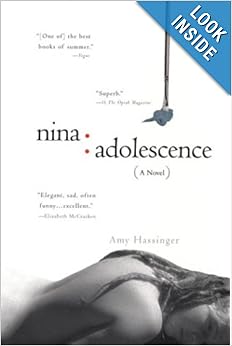
NINA: ADOLESCENCE by Amy Hassinger
Nina: Adolescence tells the story of an
adolescent Nina who struggles with problems both relatively common (sexuality,
body changes) and relatively uncommon (little brother's death, adultery) for teens.
The story is told solely from Nina's point of view with no head-hopping and no
omniscience. I read this book in three sittings over a one week period so on the
can't-put-it-down-scale of one for I couldn't even finish it to
ten for I was up until the wee morning hours, I would give it an
eight.
The year of 1987 wasn’t referenced (or at
least I didn't pick it up) until about mid-book; however, I could tell it
wasn't contemporary by the mention of using the paper card catalog at the
library and the lack of mention of cell phones or computers. The story struck
me as someone looking back over her teen years, discovering how the past led
her to the choices she made, but showing that rather than stating it outright.
Nina is a compelling character and she ate
at me even when not reading; for the first time in a long, long time, I found
myself thinking about her between readings and I could read for two hours
feeling like it passed in an instant. I was only occasionally jolted back to
reality by my son's video games or the infrequent need to re-read a sentence.
The images in the book are startling; they are detailed but in a new way, more
detailed in the feeling rather than the tangible.
The themes of teenage depression and being
lost are universal so the uniqueness of this story was how they manifested. At
the end, Nina seems okay; she comes clean with her parents and starts
medication, leading me to question if it was a brain chemical imbalance causing
her problems all along. Therapy is mentioned but there are not a lot of details
about it, but do I even need those details? The reader knows the problems centered
around Nina dealing with her brother’s loss, exposure by her mother in her
paintings and over reliance on her until her mother didn’t need her any longer,
breakdown of her parents’ marriage, and the guilt over believing she was
responsible for her brother’s death. These are obvious, but I’m still wondering
about simply coming clean and getting on medication leading to her recovery.
But maybe that’s the way it is. I cannot attribute my recovery from teen
depression to any one thing; it was a just a gradual realization and decision
to live. Maybe one just spirals down as far as he or she can go so all there is
to do is to pick back up?
But these questions, these thoughts, these contemplations are what
I loved about this book. It made me think about my own life and human behavior.
There is no mystery in how what Nina experienced led to her choices and
suffering, but those experiences were not so clear to Nina or those around her
at the time. This book is not for those interested in vampires, werewolves, or
fantasies but those who want to think about and experience one perspective about
the real problems and falterings of the human mind.
Overall, the book was superb. I found the
writing quality, pace, plot, and characters excellent.
Source: Hassinger, Amy. 2003. Nina:
Adolescence. Blue Hen Books: New York.
Subscribe to:
Posts (Atom)